Mahjong Rules
The complete rules of mahjong on one page — tiles, turn structure, melds, calling, and what counts as a winning hand.
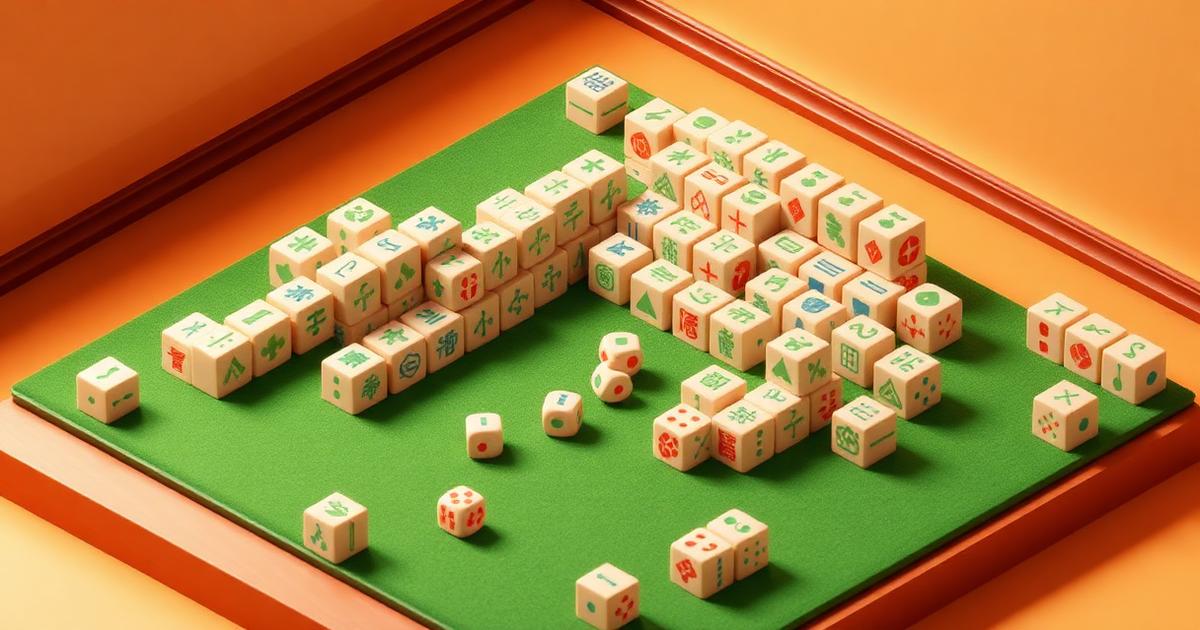
Players and equipment
Mahjong is played by four players seated around a square table. You need a set of 144 tiles, two dice, and counters or chips for scoring. Three-player and two-player variants exist but the four-player game is the standard.
The tiles
- Suit tiles (108): dots, bamboo, and characters — numbered 1–9, four of each.
- Honor tiles (28): four winds (E/S/W/N) and three dragons (red, green, white), four of each.
- Bonus tiles (8): four flowers and four seasons — set aside when drawn and replaced by a fresh tile.
Setting up
Shuffle face-down. Each player builds a wall 18 tiles wide, two tiles high in front of them. The four walls form a closed square. The dealer (East) rolls dice to break the wall and deals tiles four at a time until every player holds 13. East takes one more to reach 14 and discards to open play.
Turn order
Turns move counter-clockwise. On your turn you must:
- Draw one tile from the live wall (or claim the previous discard).
- Optionally expose a meld.
- Discard one tile face-up.
Legal melds
- Chow — three consecutive tiles in one suit. Only callable from the player to your left.
- Pung — three identical tiles. Callable from any player's discard.
- Kong — four identical tiles. Callable from any discard; draw a replacement tile after exposing one.
Calling a discard
When another player discards a tile that completes a meld for you, call out the meld name (chow, pung, kong, or mahjong) before the next player draws. Calls for pung, kong, and mahjong override a chow. Expose the meld face-up and play continues from your discard.
Winning hand
A standard winning hand is four sets and one pair totaling 14 tiles. Special hands like seven pairs or thirteen orphans are recognized in some variants. On a winning draw, declare mahjong, reveal your hand, and score the round.
Draw (exhaustive) hand
If the wall runs out before anyone wins, the hand ends in a draw. No points are scored, and the dealership usually stays with East for one more round.
Scoring varies by variant
Hong Kong, Japanese riichi, classic Chinese, and American (NMJL) mahjong all share the basic play loop above but score very differently. If you're learning with friends, pick one variant and stick to it for your first few sessions.