How to Play Mahjong: A Step-by-Step Guide
Mahjong looks intimidating because of the tiles, but the game underneath is simple: draw a tile, discard a tile, and try to be the first to assemble four sets and a pair.
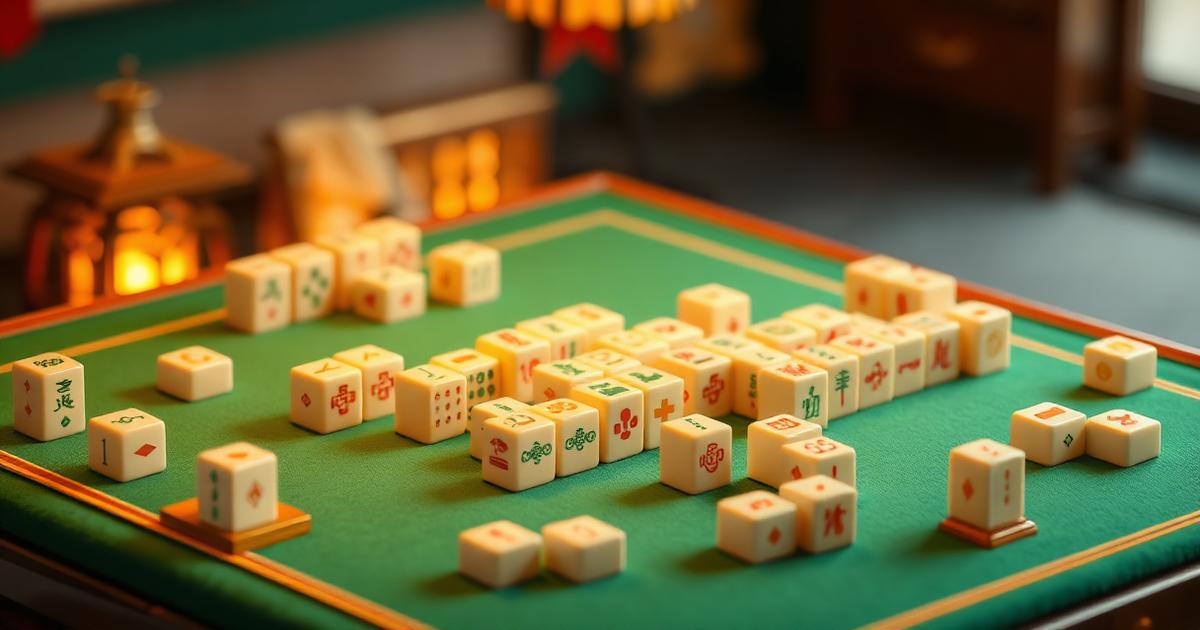
The goal of the game
Mahjong is a four-player game (three or two in some variants) where each player builds a hand of 14 tiles made of four sets and one pair. The first player to complete a legal hand calls "mahjong" and wins the round.
The tiles
A standard set has 144 tiles, in five groups:
- Dots (circles) — numbered 1–9, four copies of each.
- Bamboo (sticks) — numbered 1–9, four copies of each.
- Characters (wan) — numbered 1–9, four copies of each.
- Winds — East, South, West, North, four copies of each.
- Dragons — Red, Green, White, four copies of each.
- Bonus tiles — flowers and seasons (used in some variants).
Setting up the wall
Shuffle the tiles face down. Each player builds a wall in front of them that's 18 tiles long and 2 tiles tall. The four walls together form a square — this is the source of every tile you'll draw during the hand.
Dealing the hand
The dealer (East) rolls dice to decide where to break the wall, then deals tiles around the table four at a time until each player has 13. East then draws one extra to start with 14 and discards one to begin the round.
The turn cycle
- Draw a tile from the wall.
- Decide whether it helps your hand.
- Discard one tile face-up in the middle of the table.
Play passes counter-clockwise — to the player on your right.
Melds: pung, kong, chow
The four sets in your hand are usually one of three shapes:
- Pung — three identical tiles (e.g. three 5-bamboo).
- Kong — four identical tiles. When you complete one, draw a replacement tile.
- Chow — three tiles in sequence in the same suit (e.g. 4-5-6 dots).
You can "call" a discard from any other player to complete a pung or kong immediately; you can only call a chow from the player to your left.
Winning the hand
On your turn, if your draw (or another player's discard) completes four sets + a pair, declare mahjong and reveal your hand. Scoring then depends on the variant: classic Chinese, Hong Kong, Japanese riichi, and American (NMJL) all score differently.
From here
Reading is one thing — your first real hand makes it click. The fastest way to learn the rhythm of draws, discards, and calls is to play a few rounds against bots that won't judge your pace. That's exactly what Mahjong Pop is for.