How to Play Chinese Mahjong
Chinese mahjong is the original four-player game and the parent of every regional variant. Here's how a full hand plays out.
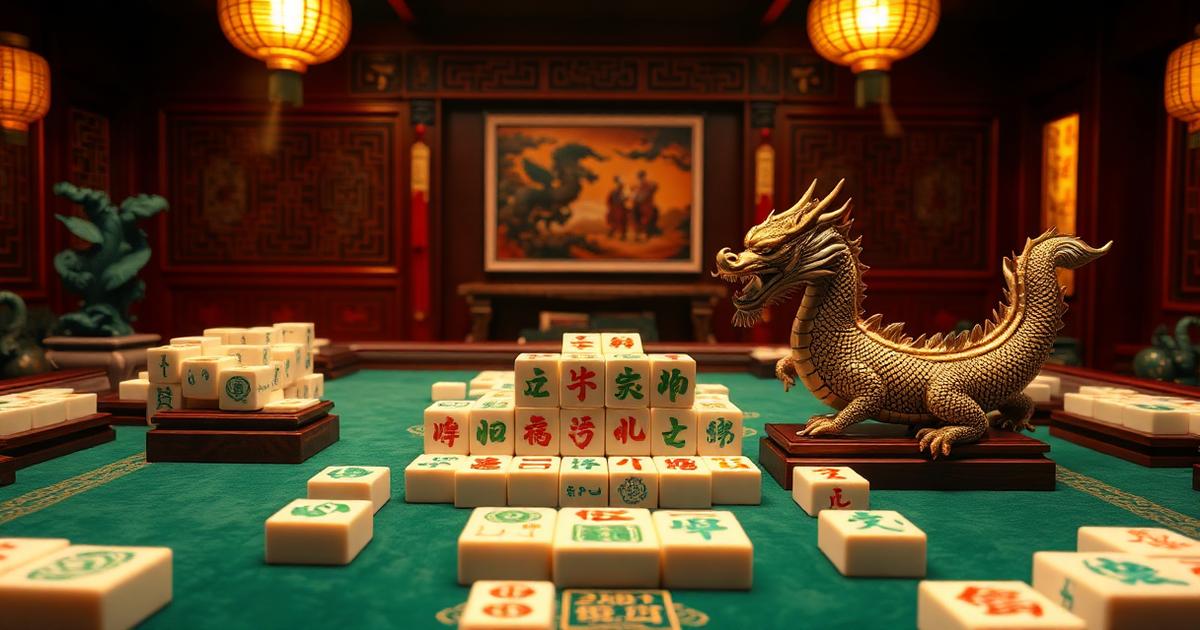
Seating and winds
Players are assigned the four winds — East, South, West, North — and sit in that order counter-clockwise. East is the first dealer. Each round has a prevailing windthat affects scoring; a full game cycles through all four prevailing winds.
Building the wall
All 144 tiles are shuffled face-down. Each player builds a wall 18 tiles wide and 2 tiles tall. The four walls together form a closed square. East rolls dice to break the wall and tiles are dealt four at a time until each player has 13 (East takes one extra).
The turn
- Draw a tile from the live end of the wall.
- Optionally expose a kong or declare a concealed kong (and draw a replacement tile).
- Discard one tile face-up.
Play passes counter-clockwise. A turn ends with a discard.
Melds
- Chow (顺子) — three consecutive tiles in one suit. Only callable from the player to your left.
- Pung (刻子) — three identical tiles. Callable from any discard.
- Kong (杠子) — four identical tiles. Callable from any discard; draw one extra tile after exposing.
Winning the hand
A standard winning hand in Chinese mahjong is four sets and one pair. Special hands like Seven Pairs, Thirteen Orphans, and All Honors are also recognized.
Scoring (Hong Kong style)
Many beginners learn the Hong Kong scoring system because it's simple: a winning hand earns a base number of faan from pattern bonuses (all one suit, all pungs, dragon pungs, seat wind pung, etc.), and that translates to a payout from the other players. Hands below a minimum faan threshold can't be declared.
Common pattern bonuses
- All one suit — every tile in your hand is from the same numbered suit.
- All pungs — no chows in your hand.
- Dragon pung — three of any dragon.
- Seat or prevailing wind pung — three of your seat wind or the round's prevailing wind.
Try it
Chinese mahjong is the default ruleset in Mahjong Pop. Open the game in your browser, pick a difficulty, and play through a full hand to see how the round flow feels in practice.